

MIDDLE EAST / GLOBAL — President Trump stated on April 1 that Iranian President Masoud Pezeshkian had requested a ceasefire. Iran’s Foreign Ministry Spokesperson Esmail Baghaei said the same day that the statement was “false and baseless.”


Hours later, Pezeshkian posted an open letter addressed to the American people on his official social media account that reached 1.7 million views.
He wrote that Iran “has never, in its modern history, chosen the path of aggression, expansion, colonialism, or domination” and that “continuing along the path of confrontation is more costly and futile than ever before.”
The disputed exchange and Pezeshkian’s letter emerged as coalition operations have expanded across three continents.
The United Kingdom, the United Arab Emirates, Kuwait, Saudi Arabia, Jordan, Australia, and France have each reported active military deployments or engagements. Canada and Germany have stated they will not participate.
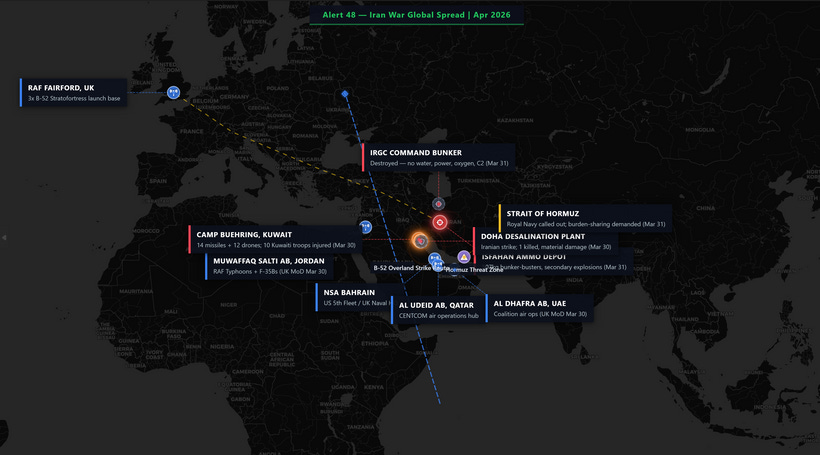
NATO Secretary General Mark Rutte cited commitments from more than 30 countries to ensure sea lane access.
According to the International Energy Agency (IEA), the Strait of Hormuz closure represents “the largest supply disruption in the history of the global oil market.” Governments from the Philippines to New Zealand have imposed emergency energy measures.
Legal Status of U.S. Operations: Is the United States Officially at War?
The United States has not formally issued a declaration of war against Iran. The Trump administration is conducting operations under Article II Commander-in-Chief authority.
The White House submitted a War Powers Resolution notification to Congress on March 2, 2026, initiating the 60-day clock under the War Powers Resolution. Secretary of State Marco Rubio stated the administration had “overcomplied with the law.”
Congress has not passed an Authorization for Use of Military Force for Iran operations. On March 4, the Senate rejected a War Powers Resolution that would have required the administration to seek congressional consent, 47 votes in favor to 53 against. On March 5, the House rejected a similar resolution, 212 votes in favor to 219 against.
No existing AUMF (including the 2001 or 2002 authorizations that governed post-9/11 operations) has been cited by the administration as operative legal authority for Operation Epic Fury, according to Lawfare.
Administration officials have used “military operation” exclusively in official statements and press briefings, not “war,” as a legal or documentary designation. The War Powers Resolution 60-day clock, filed approximately March 2, expires approximately May 1, 2026.
The current U.S. military alert level (DEFCON) is classified and not publicly released by the government. The most recent DEFCON change on the public record was September 11, 2001.
Assessment: The conflict meets the practical definition of war: the president ordered armed forces into sustained combat operations against a foreign state, with casualties reported on multiple sides.
It does not meet the constitutional definition: Congress has not issued a war declaration and rejected two legislative measures that would have imposed oversight.
The operative legal deadline is approximately May 1, 2026, when the War Powers Resolution clock expires. Congressional action or inaction by that date is the next formal legal threshold for the administration’s authority to continue operations.
