

MIDDLE EAST — The Pentagon briefed reporters on April 16 as the U.S. naval blockade of Iranian ports entered its fourth day. Secretary of War Pete Hegseth told Iran’s military leadership the United States is “locked and loaded” on the country’s energy infrastructure and that Iran faces a choice between a deal and the destruction of its remaining economic capacity.
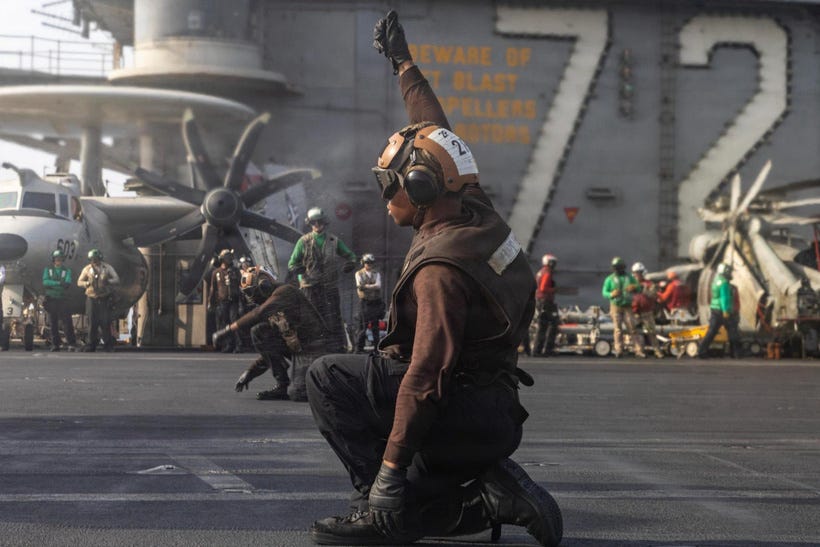


Trump Sets 8 PM Deadline for Iran as Tehran Submits 10-Clause War Termination Proposal via Pakistan
Chairman of the Joint Chiefs General Dan Caine reported 13 ships turned away since April 13, with zero breaches of the enforcement line.
U.S. Central Command (CENTCOM) Commander Admiral Brad Cooper, returning from his second trip to the region in 15 days, reported more than 50,000 service members deployed across 70 locations.
The Treasury Department launched Operation Economic Fury on April 15, threatening secondary sanctions against foreign financial institutions and announcing that the authorization for stranded Iranian oil sales will not be renewed.
Trump said on April 16 that Israel and Lebanon agreed to a 10-day ceasefire. The State Department reported that an April 14 trilateral meeting in Washington was the first major high-level engagement between the two governments since 1993.
The Joint Maritime Information Center (JMIC) rated the regional maritime threat level CRITICAL, flagging unverified reports of mines in the Strait of Hormuz.
Hegseth to Iran’s Military Leadership: “Choose Wisely”
Hegseth addressed Iran’s military leadership directly during the April 16 briefing. He named three categories of Iranian infrastructure as potential strike targets, described Iran’s military as unable to rebuild, and called the blockade the less destructive of two options available to the United States.
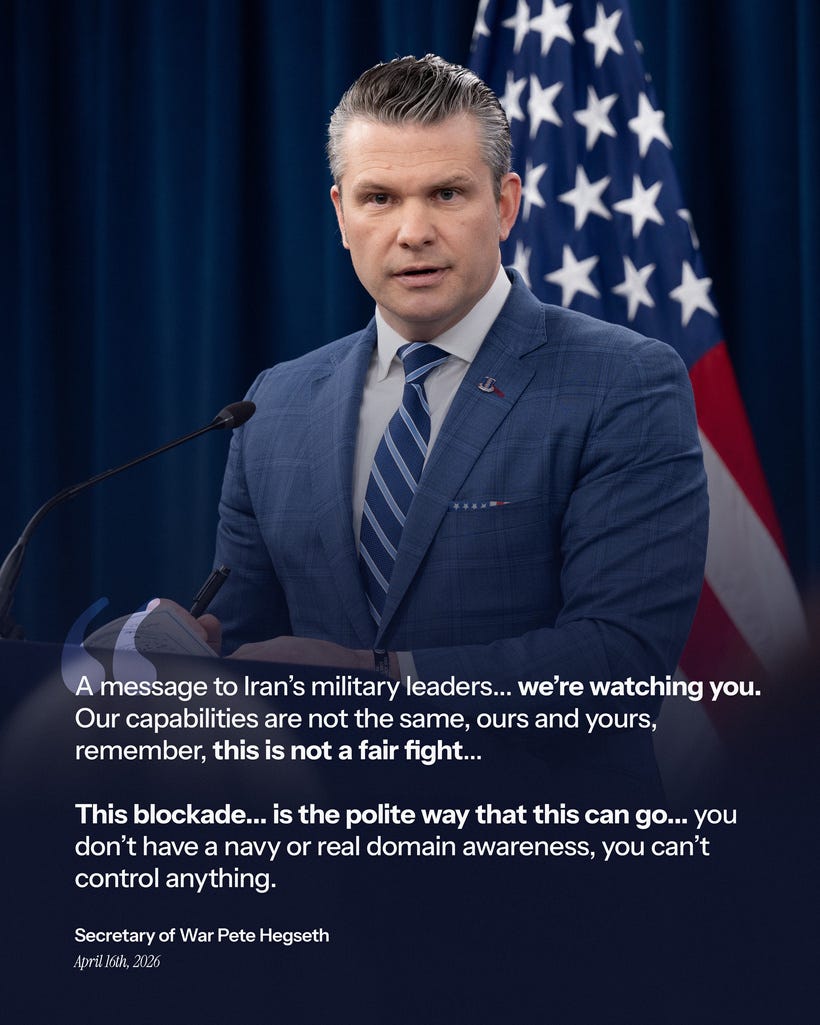
Hegseth said the United States knows “what military assets you are moving and where you are moving them to” and that Iran is “digging out of bombed out and devastated facilities” with “no defense industry, no ability to replenish your offensive or defensive capabilities.”
“You only have what you have; you know that and we know that,” Hegseth stated. “You can move things around, but you can’t actually rebuild. You can dig out for now, but you can’t reconstitute. But we can; we are reloading with more power than ever before.”
According to Hegseth, U.S. forces are “locked and loaded on your critical dual use infrastructure, on your remaining power generation and on your energy industry.” He added, “We’d rather not have to do it, but we’re ready to go at the command of our President and at the push of a button.”
Hegseth said the blockade is “the polite way that this can go,” stating that Iran’s energy industry “is not destroyed yet” but that if Iran “chooses poorly, then they will have a blockade and bombs dropping on infrastructure, power, and energy.”
He stated the U.S. Navy is enforcing the blockade with “less than 10 percent of America’s Naval power” and that Iran has “zero percent” of its navy remaining. He said Iran’s claim to control the Strait of Hormuz amounts to threatening “to shoot missiles and drones at ships, commercial ships that are lawfully transiting international waters” and that “that is not control, that’s piracy, that’s terrorism.”
Assessment: Hegseth’s public enumeration of specific target categories (dual-use infrastructure, power generation, energy industry) goes beyond general deterrence language used in prior briefings.
Naming the target set publicly while the ceasefire holds positions the threat as a coercive instrument tied to the negotiating timeline rather than an operational directive. The “less than 10 percent” framing communicates both current capability and reserve capacity.
Blockade Operations: 13 Ships Turned Away, Zero Breaches
General Caine walked through the blockade’s operational sequence during the April 16 briefing, using common operating picture graphics from the first four days. He detailed the enforcement scope, intercept procedures, and the extension of interdiction authority beyond CENTCOM’s area of responsibility.

Caine said the blockade “applies to all ships, regardless of nationality, heading into or from Iranian ports” and is “a blockade of Iran’s ports and coastline, not a blockade of the Strait of Hormuz.” Enforcement occurs “inside Iran’s territorial seas and in international waters,” Caine stated.
Caine added that beyond CENTCOM’s area, “the Joint Force, through operations and activities in other areas of responsibility, like the Pacific Area of Responsibility under the command of Admiral Paparo, will actively pursue any Iranian flagged vessel or any vessel attempting to provide material support to Iran.”
This includes what Caine described as “Dark Fleet vessels carrying Iranian oil” (illicit ships evading international regulations, sanctions, or insurance requirements).
Caine said of the intercept procedure: as potential blockade runners approach, “a range of intelligence, surveillance, reconnaissance and tactical assets” move ahead of them. A lead destroyer, supported by air power from the USS Abraham Lincoln strike group, closes on approaching vessels. A junior officer on the bridge transmits the following:
“Do not attempt to breach the blockade. Vessels will be boarded for interdiction and seizure, transiting to or from Iranian ports. Turn around or prepare to be boarded. If you do not comply with this blockade we will use force.”
Caine said this sequence has been “rehearsed multiple times and executed now 13 times since the blockade has begun.” Any ship crossing the blockade line “would result in our sailors executing pre-planned tactics designed to bring the force to that ship, if need be, board the ship and take her over,” including “a series of escalated force options, which could include warning shots and others.”
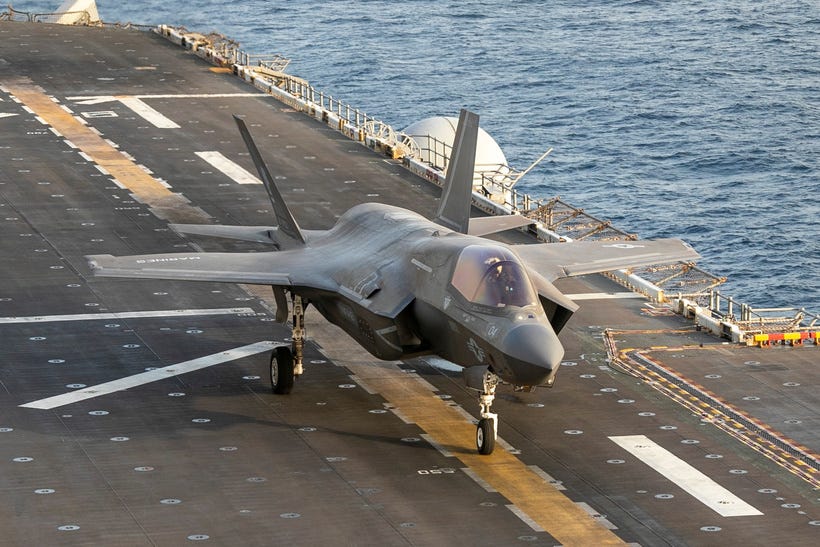
As of April 16, CENTCOM “has not been required to board any particular ships,” Caine said. CENTCOM posted on April 16 that “U.S. naval vessels are on patrol in the Gulf of Oman as CENTCOM continues to execute a U.S. blockade on ships entering and departing Iranian ports. U.S. forces are present, vigilant, and ready to ensure compliance.”
Assessment: The 13-ship turnaround figure, up from 9 at the 48-hour mark reported on April 15, indicates continued merchant vessel approaches despite the blockade’s public announcement.
The sustained zero-breach rate combined with increasing turnarounds suggests commercial shipping continues testing the enforcement perimeter while compliance holds.
The extension of interdiction authority to U.S. Indo-Pacific Command (INDOPACOM) for Dark Fleet vessels in the Pacific expands the blockade’s geographic scope beyond the Middle East.
Earlier Blockade Milestones: 36 Hours to Full Halt
Admiral Cooper reported on April 15 that the blockade had been fully implemented, with U.S. forces halting all Iranian maritime trade within 36 hours of its start. CENTCOM tracked compliance through the first 48 hours, reporting a rising number of vessel turnarounds and zero breaches.
Cooper stated, “A blockade of Iranian ports has been fully implemented as U.S. forces maintain maritime superiority in the Middle East.
An estimated 90% of Iran’s economy is fueled by international trade by sea. In less than 36 hours since the blockade was implemented, U.S. forces have completely halted economic trade going into and out of Iran by sea.”
During the first 24 hours, zero ships breached the blockade and six merchant vessels complied with U.S. direction to turn around, according to CENTCOM.
By the 48-hour mark, the zero-breach record held and the turnaround count rose to nine. CENTCOM stated on April 15, “During the first 48 hours of the U.S. blockade on ships entering and exiting Iranian ports, no vessels have made it past U.S. forces.”
USS Tripoli (LHA 7), an amphibious assault ship, is operating in the Arabian Sea with 3,500 sailors, embarked Marines, and F-35B stealth fighters. CENTCOM reported that “Tripoli and its 3,500 Sailors and embarked Marines are executing the mission to blockade ships entering and departing Iranian ports.”
Iran had been collecting transit tolls of up to $2 million per vessel through its own Strait of Hormuz restrictions since the start of the conflict, according to CENTCOM. The U.S. blockade now targets the revenue source those tolls were protecting.
Assessment: The progression from 6 vessels turned around at 24 hours, to 9 at 48 hours, to 13 as of April 16 shows a sustained rate of approximately 3 to 4 new approaches per day despite the blockade’s public announcement.
The zero-breach record across all 13 encounters, without a single boarding, indicates that the combination of naval presence, radio warnings, and visible air power has been sufficient to compel compliance without physical enforcement.
Operation Economic Fury: Treasury Moves on Secondary Sanctions
The U.S. Department of the Treasury on April 15 detailed the economic component of the pressure campaign against Iran, threatening secondary sanctions against foreign banks and ending the authorization for stranded Iranian oil sales.
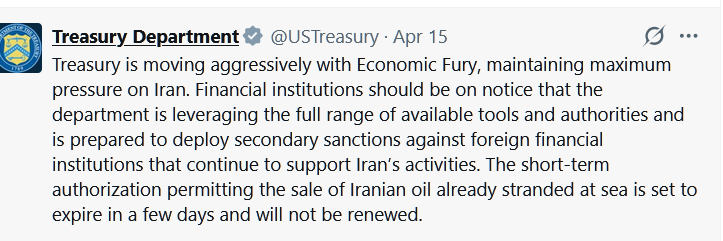
The Treasury stated, “Treasury is moving aggressively with Economic Fury, maintaining maximum pressure on Iran. Financial institutions should be on notice that the department is leveraging the full range of available tools and authorities and is prepared to deploy secondary sanctions against foreign financial institutions that continue to support Iran’s activities.”
The Treasury added, “The short-term authorization permitting the sale of Iranian oil already stranded at sea is set to expire in a few days and will not be renewed.”
Hegseth stated at the April 16 briefing that “Treasury Secretary Scott Bessent and our friends over at Treasury are launching Operation Economic Fury as well, maximizing economic pressure across the entirety of the government.”
Assessment: The Treasury statement specifies two concrete measures: the threat of secondary sanctions against foreign financial institutions and the expiration without renewal of the authorization for stranded Iranian oil sales.
The secondary sanctions threat targets the financial infrastructure supporting Iran’s remaining trade channels, while the oil authorization expiry removes the last legal mechanism for selling Iranian crude already at sea. Together with the naval blockade, these measures target both the physical movement and financial processing of Iranian trade.
